
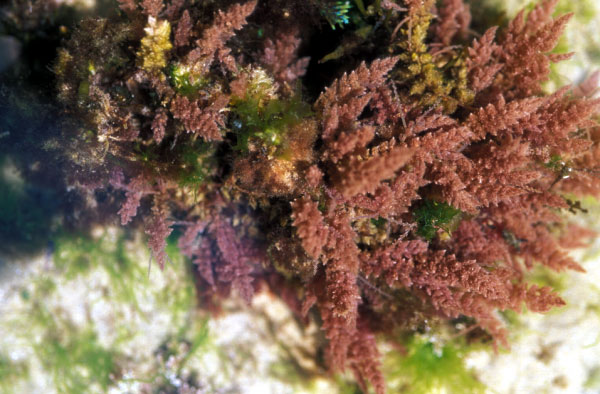
Life history interactions between the red algae Chondrus crispus (Gigartinales) and Grateloupia turuturu (Halymeniales) in a changing global environment
The invasive rhodophyte Grateloupia turuturu is a large perennial alga, discovered first in Narragansett Bay (Rhode Island) in 1994 and subsequently in the Long Island Sound estuary. The alga's low intertidal to shallow subtidal distribution overlaps that of the native Chondrus crispus. Our field measurements suggest that physical disturbance may promote increased substrate cover by G. turuturu. Molecular quantification of spore abundance suggests G. turuturu produces fewer spores, which also disperse shorter distances than spores of C. crispus. However, sporelings of G. turuturu grew faster than those of C. crispus at all environmentally relevant light levels, salinities and temperatures tested. In addition, the temperature tolerance of G. turuturu sporelings was broader; C. crispus sporelings died just after germination at 30°C; whereas, those of G. turuturu survived. The results have implications for community shifts as coastal waters continue to warm into the future.



Marine Agronomy Group, CAFNRM, UH-Hilo
200 W. Kawili st., HI 96720, USA
Contact: Marine.Agronomy.Group@gmail.com
Funding for this web portal is provided by the World Wildlife Fund and the University of Hawaii-Hilo.